


Goodbye Pie Chart, Hello Phase 1 Sliders
Written by Allison Smith, ND | 2025

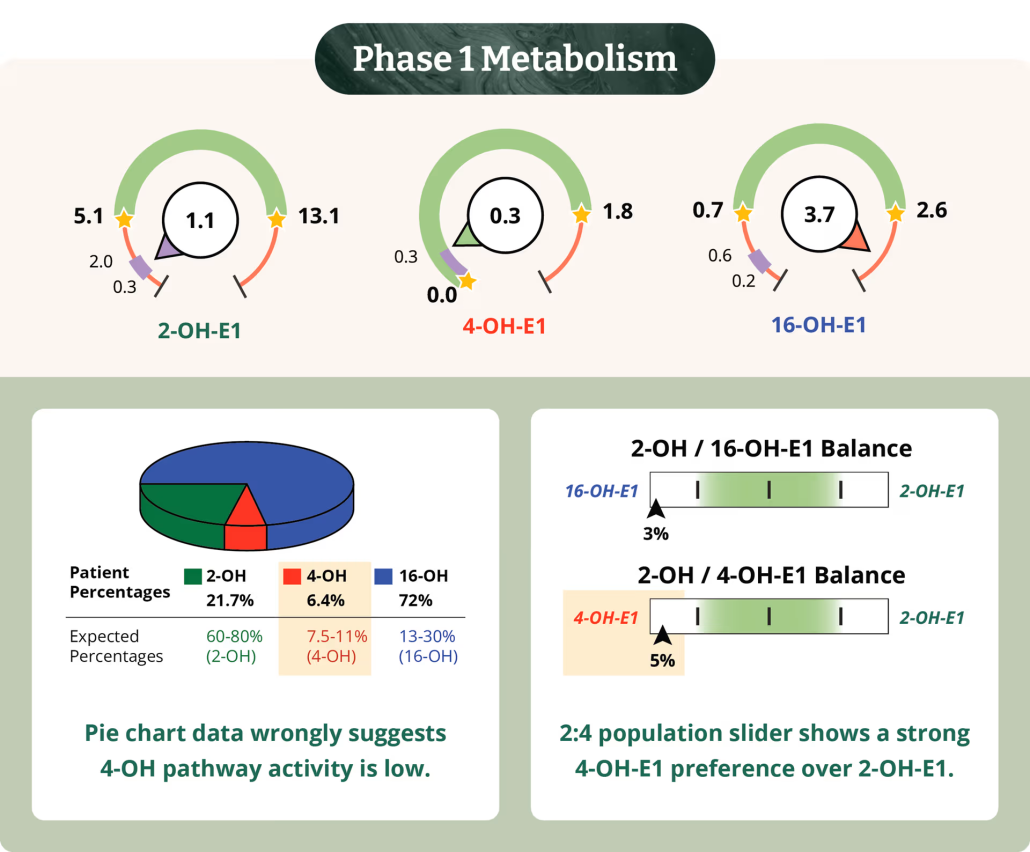
As we usher in a new era of DUTCH testing which leaves behind the concept of the three-way ratio that compared 2-OH-E1, 4-OH-E1, and 16-OH-E1 in favor of the two-way ratios that directly compare 4-OH-E1 to 2-OH-E1 and 16-OH-E1 to 2-OH-E1, it’s important to align on why we are making this change and exactly how we convey the Phase 1 estrogen metabolism data on the DUTCH report.
Why is the Estrogen Metabolism Phase 1 three-way ratio pie chart being removed from the report?
- Our aim is to create consistency with published research (including our own) on Phase 1 metabolism of estrogen which assesses 2-OH/4-OH-E1 (2:4) and 2-OH:16-OH-E1 (2:16) ratios as direct ratios
- To tease out important concepts which were previously lumped together in the pie chart assessment, including:
- Low 2:4 ratio – genotoxic risk
- Low 2:16 ratio – high estrogenic activity
- In order to reduce potential error in assessment of 4-OH-E1
- When 16-OH-E1 is dominant (as commonly found in endometriosis, fibrocystic breast disease, autoimmune disease, gut dysbiosis, and even with first pass metabolism of oral or sublingual estriol), the 3-way pie chart ratios can misrepresent 4-OH-E1 as normal or low even when it is highly dominant over 2-OH-E1
- This can lead to an incorrect assessment of 4-OH-E1 and undertreatment or choosing a treatment that may exacerbate a low 2:4 ratio (4-OH preference)

Where can I find the actual 2:16 ratio and 2:4 ratio on the DUTCH report?
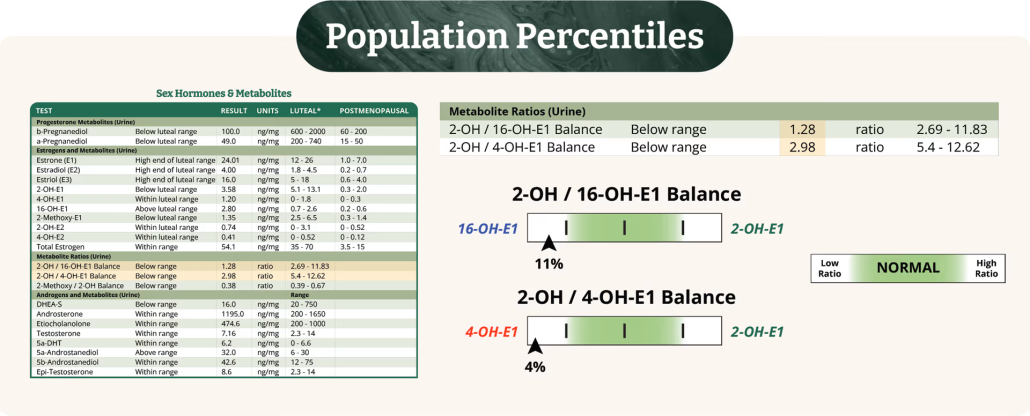
The 2:16 ratio and 2:4 ratio can always be found on the Sex Hormones and Metabolites page’s table list of findings. This is page 3 of a DUTCH Complete, DUTCH Plus, and DUTCH Sex Hormones Panel. These ratios inform the population percentiles which are presented in slider bars located on the Hormone Testing Summary page 1 and also on the Expanded Sex Hormones and Androgens page 2.
Remember, within these ratios the 2-OH-E1 is in the numerator and the 16-OH and 4-OH-E1 are the denominators. This means that if 16-OH or 4-OH-E1 are high relative to 2-OH-E1, that ratio becomes very low. Conversely, if they’re low compared to 2-OH-E1, then those ratios become high. For instance, when a person uses diindolylmethane (DIM), we will often see an ‘above range’ 2:16 ratio which falls into the population percentile greater than the 80th%, which indicates a strong 2-OH preference over 16-OH-E1.
What do the percentages (%) mean on the Phase 1 Slider Bars for 2-OH/16-OH-E1 Balance and 2-OH/4-OH-E1 Balance?
The 2:4 and 2:16 ratios inform the Phase 1 population sliders displayed on pages 1 and 2 of the DUTCH Complete, Plus, and Sex Hormones Panel. The population percentile sliders answer the question, “Where does my patient’s ratio fall compared to the population?” A low 2/4 or 2/16 ratio will fall below the normal expectation in the population range into a percentile less than the 20th%. A high 2/4 or 2/16 ratio will be expressed in the percentile slider greater than the 80th%.
In the example below, we can see the patient has a 2/16 ratio of 1.28. This falls below the normal range. How does this compare to the population?

Within the population, this patient has a 2/16 ratio higher than only 11% of people. Maybe more importantly, this also means that they’re lower than 89% of people in that population. And because a low 2:16 ratio represents a strong preference for the 16-OH-E1 over the 2-OH-E1, this person has a higher risk phase one metabolism.
Applying the same rationale to the 2:4 ratio, we can see the 2/4 balance is 2.98 which is below normal range. Within the population, this patient has a 2/4 ratio higher than only 4% of people and that means they’re lower than 96% of people in that population. This represents a strong preference for the 4-OH-E1 over the 2-OH-E1 and potential for more genotoxic activity especially when inflammation and oxidative stress is present.

Does it ever make sense to treat a patient based on Phase 1 metabolism ratios that fall within the normal population percentile range?
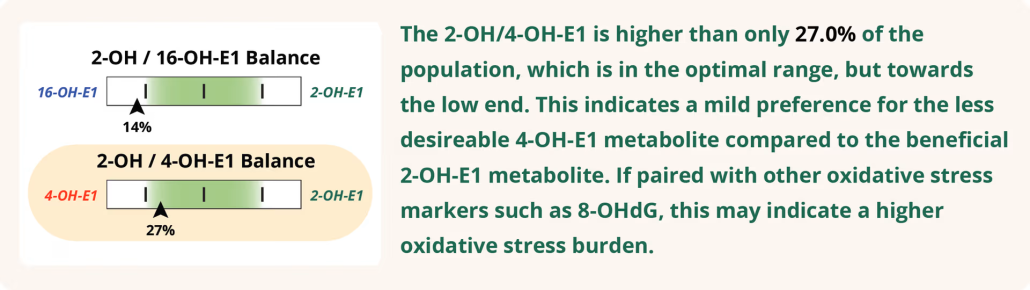
Absolutely! Remember, even a “normal” Phase 1 ratio can be actionable depending on other aspects of a patient’s risk profile, their symptoms, hormone levels, their relative balance, and presence of indicators of oxidative stress burden (high 8-OHdG and pyroglutamate, high cortisol clearance rate, etc).
Below, notice the 2:4 balance is within the normal range but toward the lower edge of normal. We see this patient has a strong preference toward 16-OH-E1. The next step could be to assess markers of oxidative stress and inflammation which drives 4-OH-E1’s genotoxicity – the presence of high cortisol, quinolinate, 8-OHdG, and/or pyroglutamate levels on the DUTCH test may help determine the need to treat a mild preference for 4-OH-E1.

We hope you discover the value of using the 2:4 and 2:16 ratio data and population percentile sliders for more fully and reliably representing a person’s Phase 1 estrogen metabolism as we retire our old friend, the DUTCH Phase 1 Pie Chart. To health!
Connect with a functional medicine practitioner near you – use our Find a Practitioner tool today!
Share:
Related Posts

TUDCA vs. Milk Thistle: Which One Supports Your Liver Best?
Written by Ashley Palmer & Pooja Mahtani | 2025 Key Takeaways: TUDCA is a bile acid that enhances bile flow, reduces liver inflammation, and supports

14 Common Questions About PectaSol Modified Citrus Pectin
Written by ecoNugenics An increased interest in natural therapies to treat the body has led to exciting research into a variety of supplements. One common

Benefits of Creatine in Perimenopause and Menopause
Written by Maura MacDonald, MS, RD, CSSD | 2025 As we age, the notion is that we will inevitably become weaker. Not as mobile as

Introducing the DUTCH Dozen
Written by Kelly Ruef, ND | 2025 Hormone testing can be complex, which is why Precision Analytical developed the DUTCH Dozen, an interpretive framework that

DUTCH Report Enhancements
Written by Hilary Miller, ND | 2025 Precision Analytical have released the newest version of the DUTCH Test. This is the report’s most significant update